
Key takeaways
- A front door with fingerprint access reads the pattern on your finger, compares it with the prints you have registered, and releases the lock when they match.
- The fingerprint scanner controls whether the door unlocks. It works alongside the door’s own multipoint locking rather than replacing it.
- The scanner is hardwired and connected directly to the mains power supply, and every door is supplied with a manual key override for use in a power outage.
- YPE’s Spitfire Signature Series can be specified with fingerprint unlocking and passcode entry, so your finger does not have to be the only way in.
- Our Sutton showroom is open by appointment only, so a member of our Sales Team is available to show you around and answer your questions.
Summary
A front door with fingerprint access lets you unlock your home with your finger instead of a key. Here is how the technology works in plain terms, what happens in a power outage, what else you can have on a Spitfire Signature Series door, and the questions worth asking before you buy.
Introduction
Most people have used a fingerprint reader on a phone, so the idea feels familiar. On a front door it raises different questions. What happens if the power goes out? Do I still get a key? Is it complicated to live with?
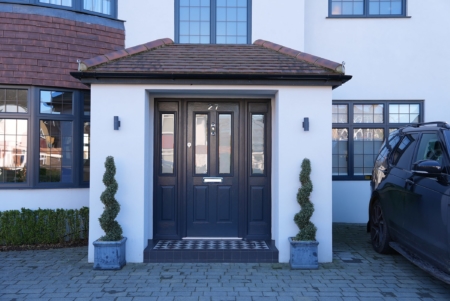
We supply and install Spitfire aluminium front doors, including the Signature Series, which can be specified with fingerprint unlocking. This guide explains how front doors with fingerprint access work so you can decide whether one suits your home.
How does fingerprint access on a front door actually work?
There are three steps, and they happen in a moment:
- Scan. A sensor reads the pattern of ridges on your fingertip.
- Compare. The system turns that pattern into a digital record and compares it with the prints that were registered when the lock was set up.
- Release. If there is a match, the system tells the lock to release. If there isn’t, the door stays locked.
In most systems the stored information is a digital record of the pattern rather than a photograph of your finger, but how it is stored varies by system, so it is worth asking for the detail on the one you choose. Fingerprint sensors also come in different types, such as optical and capacitive. This plain-English explainer on fingerprint sensor types covers the differences.
Is a fingerprint the only way to open the door?
No. The Spitfire Signature Series can be specified with fingerprint unlocking and passcode technology. That means you can choose how the household gets in, rather than relying on one method alone.
Having a second option matters in practice. A passcode is useful for someone whose fingerprint doesn’t read well, or for letting a trusted person in without registering their finger.
How does the electronic lock work with the physical locking?
The fingerprint scanner decides whether the door unlocks. The strength of the door itself comes from its locking hardware. Spitfire doors use multipoint locking, which holds the door at several points along its edge, and that locking works together with the biometric control system.
How secure a fingerprint lock is compared with a traditional lock is a bigger question, and we deal with it separately. For a general view of how security is tested, the police-backed Secured by Design scheme is a good place to start.
How is a fingerprint scanner powered, and what happens in a power outage?
The scanner is hardwired and connected directly to the mains power supply. If the power goes out, every front door with a fingerprint scanner is supplied with a manual key override, so you can still unlock the door with a key.
What happens if the scanner doesn’t recognise your finger?
It can happen with any fingerprint reader. Wet hands, a cut, or a very cold day can all make a read less reliable. Systems usually deal with this by letting you try again, by registering the same finger more than once, or by offering another way in such as a passcode. Your manual key override is there as well.
These are the other questions we would ask about any fingerprint system:
| Question to ask | Why it matters |
|---|---|
| How many fingerprints can be registered? | Households often have several people who need access. |
| How easy is it to add or remove a fingerprint? | Useful when a guest, tradesperson or tenant no longer needs access. |
| Where is the fingerprint information held? | Ask for the specifics of the system you are considering. |
| What does the guarantee cover? | The door and the electronics may be guaranteed differently. |
We are happy to answer these for the exact door you are considering when you ask for a quote.
What else can a Signature Series door include?
The Signature Series is YPE’s premium Spitfire range. Alongside fingerprint unlocking, you can choose from over 600 customisable designs and add optional integrated Swarovski crystals in the door sash. If you want to see the wider range, our Spitfire aluminium front doors page is the best place to start.
Who is a front door with fingerprint access right for?
It tends to suit people who:
- Don’t like carrying or losing keys
- Have a household where several people come and go
- Want a modern, premium look on the front of the house
It may suit you less if you prefer a purely mechanical lock with nothing electronic. Either choice is reasonable, and it is better to decide with the practical questions answered.
How can you see one before you buy?
Our showroom in Sutton is open by appointment only. This is to make sure a member of our Sales Team is available to show you around and answer any questions you may have. We offer free, no-obligation quotes and we have a strict no sales pressure policy. You can read more about the team and showroom or get in touch here.
If you are also comparing installers, our guide on how to compare aluminium door installers in Surrey covers what is worth checking.
Conclusion
A front door with fingerprint access works by reading your fingertip, matching it against registered prints and releasing the lock. The scanner is hardwired to the mains, and every door comes with a manual key override for a power outage. What makes the difference day to day is the detail, such as how many people can use it and how it is guaranteed.
If you would like to talk it through, get in touch for a quote or book an appointment to see Signature Series options at our Sutton showroom.
FAQs
Can I have a fingerprint lock on any front door?
Fingerprint unlocking is an option on the Spitfire Signature Series, rather than something every front door has. Ask us which doors it can be specified on.
Does a fingerprint scanner run on batteries or mains power?
The scanner is hardwired and connected directly to the mains power supply.
Do I still get a key?
Yes. All front doors with fingerprint scanners are supplied with a manual key override for use in the event of a power outage.
Can more than one person use the door?
Fingerprint systems generally let you register more than one person, but the number varies. Ask for the exact figure on the system you choose.
Can I add a Swarovski crystal to a door with fingerprint access?
Yes, Swarovski crystal can be included in the door sash as an option on the Signature Series.
How much does a front door with fingerprint access cost?
The price depends on the design, size, glass and options you choose, so we quote each project individually. You can request a free quote on our contact page.
Written by Andy Boyce, Founder and Managing Director, YPE Bifold Doors
Andy has spent more than 40 years in the glazing industry, starting out as a fitter and later running his own manufacturing facility, before founding YPE Bifold Doors over 20 years ago. He remains directly involved in the day to day running of the business, including customer surveys, and personally refurbished YPE’s Sutton showroom. In 2022 he led YPE’s expansion into premium front doors through a partnership with Spitfire Doors, and was nominated for the GGP Outstanding Achievement Award in 2024.