
Key takeaways
- Accreditation matters, but check it independently rather than taking a website’s word for it. CERTASS and Secured by Design both have public registers you can search yourself.
- A guarantee is only as useful as what it actually covers. Ask specifically about parts, labor, and whether it transfers if you sell the house.
- Review volume matters less than review spread. An installer with strong ratings across two or three independent platforms is a safer bet than one with many reviews on just one.
- A showroom you can visit and touch the product in is a genuine trust signal for a purchase this size, not just a nice-to-have.
- Specialism counts. An installer who focuses on doors and windows day in, day out tends to know the product range more deeply than a general glazier who does everything.
Summary
Choosing an aluminium door installer in Surrey usually comes down to a shortlist of two or three companies that all look fairly similar on the surface. The way to tell them apart isn’t the sales pitch, it’s five concrete things: accreditation, guarantee, reviews, showroom access, and specialism. This guide walks through each one, what to actually ask, and where to check the answer yourself rather than just taking an installer’s word for it.
Introduction
If you’re researching aluminium bifold or front doors in Surrey, you’ve probably already noticed that most installers say roughly the same things. Everyone claims to be accredited, everyone has a guarantee, everyone has good reviews. That similarity is exactly why it’s hard to compare them fairly, and exactly why a homeowner shortlisting two or three companies before requesting quotes needs a proper framework rather than a gut feeling.
This isn’t a “why choose us” piece. It’s a genuine breakdown of the criteria that actually separate installers, written so you can apply it to any company you’re considering, including YPE Bifold Doors.
What accreditations should you actually check?
Almost every installer lists accreditation logos on their website. The useful question isn’t whether they have any, it’s which ones, and whether you can verify them yourself.
Two worth knowing:
- CERTASS is a a government-authorised Competent Person Scheme that checks window and door installations comply with Building Regulations and issues a compliance certificate for the work. It’s the accreditation that matters most when you come to sell the house, since this certificate is what proves the work was done to standard (CERTASS).
- Secured by Design is a police-backed accreditation for security, covering products tested to resist forced entry. It’s most relevant for front doors, where security is the main concern rather than weatherproofing or thermal performance (Secured by Design).
Both of these have a public register or verification route. If an installer states a CERTASS registration or a manufacturer partner tier such as Origin Approved, Premium or Platinum Partner, it’s worth checking that directly with CERTASS or the manufacturer rather than relying on the website alone, since partner tiers can change and vary between installers.
How long should the guarantee actually be, and what should it cover?
A guarantee length on its own doesn’t tell you much. What matters is what’s actually included.
Ask three things:
1. Does it cover parts, labour, or both?
2. Is it transferable if you sell the property?
3. Is it backed by the manufacturer, the installer, or an insurance-backed scheme that survives if the installer goes out of business?
Origin, for example, backs its aluminium doors with a manufacturer guarantee commonly cited as up to 20 years. That’s a genuinely long term by industry standards, but the manufacturer’s guarantee and the installer’s own workmanship guarantee are usually two separate things, so it’s worth asking your installer to spell out both rather than assuming one covers everything.
How much do reviews actually tell you?
Review volume gets a lot of attention, but volume on its own is a weak signal. A company with ninety reviews on one platform and nothing anywhere else tells you less than a company with strong ratings spread across two or three independent sources.
What’s worth checking:
- Spread. Google reviews are easy to accumulate and easy to game. A presence on an independent trade-specific platform, alongside Google, is a stronger combined signal.
- Recency. A high rating built entirely from reviews several years old tells you less about current standards than one with a steady flow of recent reviews.
- Content, not just star rating. Reviews that mention specific things (a named installer, a particular product, how a problem was resolved) are harder to fake than generic five star comments.
- Trade reviews, if relevant. Repeat business from tradespeople or contractors is a strong, often-overlooked signal, since trade customers have less patience for poor workmanship than a one-off homeowner might.
Does a showroom visit actually matter?
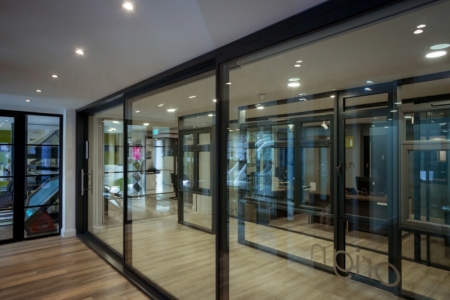
For a purchase like this, yes, more than it might seem. Photos and website renders can’t show you the difference in sightline thickness between product ranges, how a track system actually glides, or what a colour finish looks like in daylight versus indoor lighting.
An installer with a real, appointment-based showroom you can visit and open the doors yourself is giving you a chance to catch problems (a colour you don’t like, a track that feels stiff) before you’ve committed, not after installation.
Should you choose a specialist or a general glazier?
Some installers cover everything, from conservatories to roofline to general glazing repairs. Others focus specifically on aluminium doors and windows. Neither is automatically better, but the trade-off is worth knowing:
| Specialist door and window installer | General glazier | |
|---|---|---|
| Product depth | Usually deep knowledge of a smaller product range | Broader range, less depth per product |
| Manufacturer relationship | More likely to hold a specific partner tier with one manufacturer | Often works across several brands without a formal tier |
| Turnaround | Can be faster for the products they specialise in | May be slower if doors aren’t their main focus |
| Best suited to | A defined project like bifolds or a front door | Homeowners wanting several different jobs done by one company |
If your project is specifically aluminium bifold, sliding, or front doors, a specialist is usually going to have handled more of exactly your job than a generalist has.
The five-point checklist
| Criteria | What to ask | Where to check independently |
|---|---|---|
| Accreditation | Which schemes, and at what level? | CERTASS register, manufacturer’s own partner directory |
| Guarantee | Parts, labour, transferable? | Ask for it in writing, not just verbally |
| Reviews | Which platforms, how recent? | Check at least two independent sources, not just one |
| Showroom | Can I visit and see the product? | Ask for an appointment before requesting a quote |
| Specialism | Doors and windows only, or general glazing? | Check their site’s product range and case studies |
Conclusion
None of these five things is complicated on its own, but together they’re a genuinely useful way to compare installers who otherwise look identical on paper. The honest answer for any installer, including us, is that you shouldn’t take accreditation or guarantee claims at face value. Check them. A company confident in what it offers won’t mind you doing that.
If you want to see how YPE Bifold Doors holds up against this checklist, our reviews and FAQs pages cover most of it directly, If you’d like an accurate price for your own project, you can get a quote here.
FAQs
Is a more expensive installer always more reliable? Not necessarily. Price often reflects product range and brand, not workmanship quality. The five criteria above are a better indicator of reliability than price alone.
Can I ask an installer to prove their accreditation? Yes, and you should. A legitimate installer will be able to point you to a certificate number or a manufacturer’s installer directory rather than just a logo on their homepage.
Does a longer guarantee always mean better quality? Not automatically. A long guarantee that only covers parts, not labour, or one that isn’t transferable, can be worth less in practice than a shorter guarantee with fuller coverage.
Should I get quotes from both specialists and general glaziers? It’s reasonable to get one or two quotes from each, then compare using the same five criteria rather than price alone.
How many reviews is “enough” to trust an installer? There’s no fixed number. A smaller volume spread across multiple recent, detailed, independent sources is generally more trustworthy than a large volume concentrated on one platform.
Written by Andy Boyce, Founder and Managing Director, YPE Bifold Doors
Andy has spent more than 40 years in the glazing industry, starting out as a fitter and later running his own manufacturing facility, before founding YPE Bifold Doors over 20 years ago. He remains directly involved in the day to day running of the business, including customer surveys, and personally refurbished YPE’s Sutton showroom. In 2022 he led YPE’s expansion into premium front doors through a partnership with Spitfire Doors, and was nominated for the GGP Outstanding Achievement Award in 2024.